
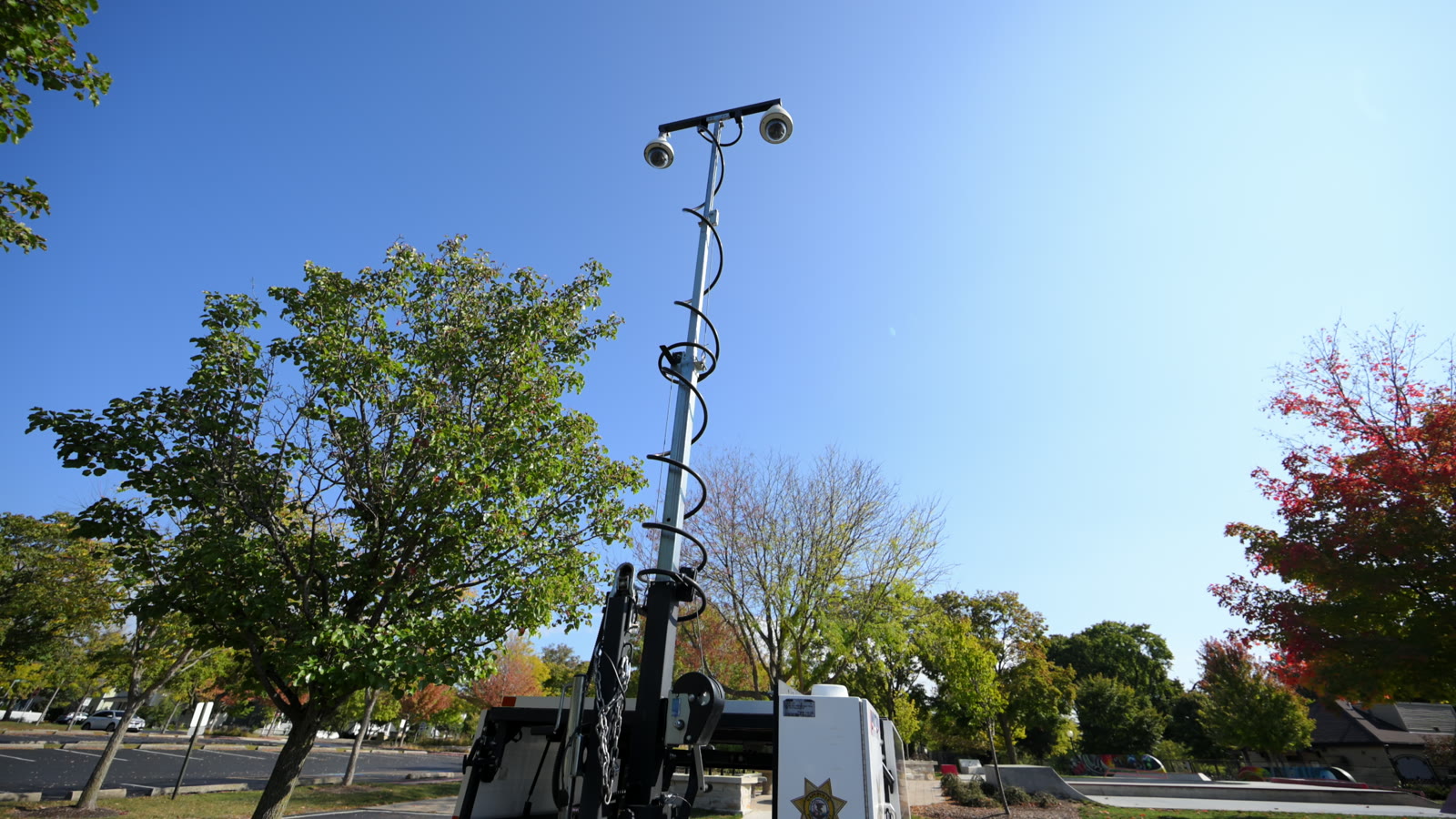
Fixed cameras have an address. Mobile cameras do not: a body camera moves with an officer, a surveillance trailer gets towed to whatever corner needs coverage this month, and an in-car system spends its shift driving a beat. For the footage from those assets to be useful as evidence or live intelligence, two problems have to be solved at once: getting the video off the asset (connectivity) and knowing where the asset was when the video was captured (location).
In practice both problems are usually solved by the same box: a cellular router with a built-in GPS receiver.
Cellular routers with GPS
Cradlepoint
Cradlepoint (now part of Ericsson) is the name you will hear most often in public safety fleets. Their ruggedized routers, such as the vehicle-focused R-series and the IBR line widely deployed in cruisers and trailers, pair LTE/5G connectivity with an onboard GNSS receiver. Location is managed through the NetCloud platform, and the router can also stream position reports directly to a server of your choosing in standard formats (NMEA sentences or TAIP), which is how a VMS or CAD system gets a live feed of where the asset is. One router gives the cameras behind it a network path and gives the platform a position for everything on that asset.
The alternatives
Cradlepoint is not the only option, and mixed fleets are common:
- Sierra Wireless AirLink (now under Semtech): the MP70 and XR series are direct competitors in vehicle and trailer deployments, with the same pattern of LTE/5G plus GNSS reporting to a management platform or a raw TAIP/NMEA target.
- Peplink: the MAX BR1 family is popular on trailers and transit, with GPS fleet tracking through InControl and support for bonding multiple cellular links when one carrier is weak at the deployment site.
- Teltonika: the RUT series offers GPS reporting at a lower price point, common in smaller municipal and private deployments.
- Digi: the WR and TX lines serve the same role in transit and public safety vehicles.
When evaluating any of them, the questions are the same: which constellations and how quickly it reports, which output formats it can push (NMEA, TAIP, MQTT, or platform API), whether it is FirstNet capable if your agency uses FirstNet, and how it behaves when the cellular link drops.
Dedicated GPS trackers
If the connectivity is already handled, or the asset only needs to be found rather than streamed from, a dedicated telematics tracker (CalAmp units and similar fleet devices) can supply the position feed on its own. This is common for towed assets like light towers and message boards that carry a camera but no router.
What this looks like per asset type
Body cameras. Modern connected body cameras, such as Axon's current bodycams and Motorola's connected line, have LTE and GPS built in: the camera itself reports position and can live-stream without a separate router. The trade-off is bandwidth: a live bodycam stream over LTE is typically a constrained sub-stream, with full-resolution footage uploading later from the dock.
Surveillance trailers. A typical solar trailer carries one or more PTZ or fixed cameras, a cellular router with GPS, and batteries. The router's GPS is what tells your platform where the trailer is parked today, so detections land on the right spot on the map without anyone re-configuring the site plan after every move.
Vehicle systems. In-car video, LPR units, and drone docks follow the same pattern: the vehicle router provides the uplink and the position, and every camera behind it inherits that location.
Getting location into the video platform
A position feed is only useful if the video platform consumes it. There are three common paths:
- Router to VMS directly. The router streams NMEA or TAIP to the VMS, which associates the position with the cameras on that asset. This is the cleanest path for trailers and vehicles.
- Platform APIs. NetCloud, AirLink Management, and InControl all expose asset positions over an API that a VMS or CAD integration can poll.
- In-stream metadata. Some cameras and encoders embed geolocation in the video metadata itself. ONVIF Profile M standardizes this kind of metadata transport; see our ONVIF profiles explainer for what Profile M covers.
EdgeTrace's Vantage VMS takes a position feed per asset and pins every stream to it, so a search result from a trailer camera comes back with coordinates attached, and a moved trailer updates itself.
Do not forget the bandwidth math
Cellular is the constraint that fixed deployments never have to think about. A single H.264 1080p stream can consume a meaningful share of an LTE uplink, and data plans are rarely unlimited at usable speeds. Three habits keep mobile assets viable:
- Prefer H.265 cameras behind the router (roughly half the bitrate of H.264 at the same quality).
- Stream a low-bitrate sub-stream for live monitoring and let full-resolution video stay on the edge recorder until it is pulled.
- Size the uplink before the deployment, not after. Our bandwidth calculator gives you the per-camera numbers; budget against the realistic uplink of the cellular plan, not the radio's theoretical maximum.